Every platform team has seen it: a Friday afternoon page traced back to an outdated library nobody knew was still running. Not a sophisticated attack. Not a complex failure. Just a dependency that drifted, silently, until it didn't.
In a single Kubernetes cluster, this is manageable. Across dozens of clusters, hundreds of repositories, and a growing engineering organization, dependency drift becomes a systemic risk — one that standard CronJobs and SaaS automation tools aren't designed to handle.
The mogenius Renovate Operator takes a different approach. The project is fully open-source under the MIT license: no paid tiers, no license keys, no vendor lock-in. Maintained by mogenius and available on GitHub, it makes dependency management a native Kubernetes workload: declarative, observable, and fully self-hosted.
Why CronJobs and SaaS Both Hit a Ceiling
Most teams start with Renovate the same way: a CronJob running the CLI on a schedule. It works, until it doesn't.
The first problem is visibility. CronJobs fail silently. When a dependency scan doesn't run because of a resource conflict or a misconfigured secret, there's no alert. There's no dashboard showing which of your 200 repositories were actually scanned this week. You find out about the gap when a CVE lands in production.
The second problem is governance. Standard CronJobs don't integrate with Kubernetes RBAC. Anyone who can create a CronJob can modify your update policies. There's no schema validation, no audit trail, and no way to enforce organizational standards across teams.
SaaS alternatives solve some of these issues but introduce a different constraint: your Git tokens and source code leave your infrastructure. For organizations operating under GDPR, ISO 27001, or NIS2, that's often a non-starter. And even when compliance isn't the driver, the operational dependency on an external service creates its own fragility.
The Renovate Operator keeps the entire lifecycle inside your cluster: scheduling, execution, monitoring, and credentials. No external dependencies, no token sharing, no data sovereignty questions.
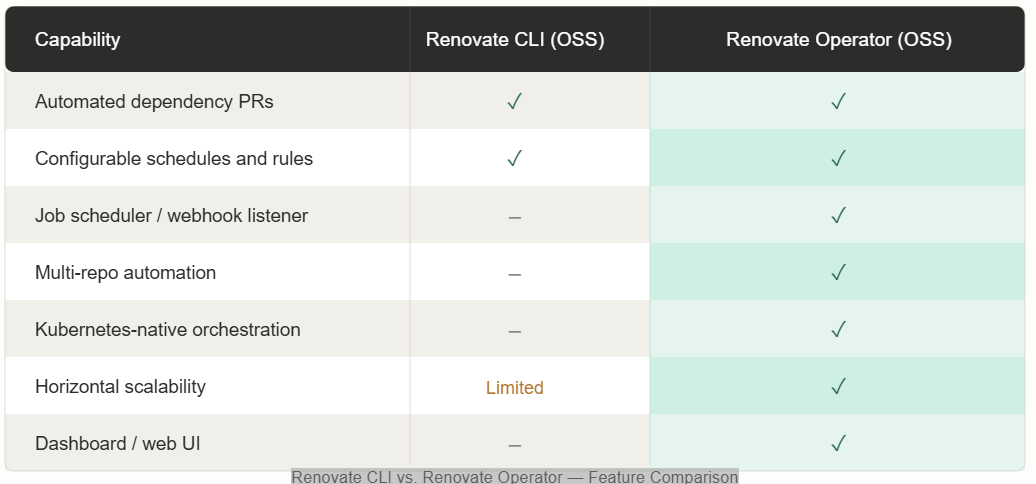
Renovate CLI vs. Renovate Operator at a Glance
What Changes with a Kubernetes-native Operator
The core shift is from scripting to infrastructure. Instead of managing Renovate through shell scripts and pipeline YAML, you define dependency policies as Custom Resource Definitions (CRDs).
This is not a cosmetic difference. CRDs give you three things that scripts can't:
Early validation. When an engineer applies a Renovate configuration with kubectl apply, Kubernetes validates the schema immediately. Misconfigurations surface at deploy time, not at 2 AM when the CronJob runs and silently fails.
Native RBAC. Kubernetes role bindings control who can create, modify, or delete update policies. This means your dependency governance integrates with the same access control model as the rest of your infrastructure.
Operational visibility. The operator includes a built-in web dashboard that shows job status, project coverage, and execution history across all repositories. No more guessing which scans ran and which didn't.
The operator is written in Go, actively maintained, and supports GitHub, GitLab, Bitbucket, Azure DevOps, Gitea, and Forgejo.
The Architecture: Three Components, One Control Loop
Under the hood, the operator runs a decoupled three-component model:
The Controller watches for changes to Renovate CRDs and manages scheduling. It reconciles every 60 seconds, ensuring that the actual state of your dependency jobs matches the desired state.
The Discovery Agent solves the onboarding problem. Using the --autodiscover flag, it crawls your Git organizations to find all repositories, including ones created after the operator was deployed. New projects get picked up automatically.
The Executor Loop handles concurrency. Every 10 seconds, it checks for scheduled jobs and starts them while respecting the parallelism limits you've configured. This prevents the API rate-limiting issues that plague teams running hundreds of Renovate instances simultaneously.
On top of this, the operator exposes Prometheus metrics and health endpoints for integration with your existing monitoring stack, and supports webhooks for event-driven execution from GitHub and GitLab.
Security Defaults That Actually Matter
The operator ships with security configurations that reflect production requirements:
All worker containers run as non-root with RuntimeDefault seccomp profiles. Resource requests and limits are enforced on every spawned job, preventing dependency scans from competing with production workloads. Git credentials are managed as native Kubernetes Secrets, or through the External Secrets Operator for teams using vault-based workflows.
Leader election is built in for high-availability deployments. If the primary operator pod goes down, a standby takes over without job interruption.
The Cost of Doing Nothing
Deferred dependency updates aren't free. They compound. Every quarter you skip a Kubernetes API deprecation or delay a library upgrade, you add to the eventual migration cost. The industry pattern is well-documented: teams that avoid incremental updates end up facing "Big Bang" migrations — high-risk, high-cost events that consume entire sprints.
Continuous dependency management through an operator doesn't eliminate change; it makes change routine. Updates arrive as pull requests, pass through your CI/CD pipeline, and merge only when tests pass. The cost per update is small. The cost of accumulating a year's worth of deferred updates is not.
Getting Started
The operator installs via Helm in under five minutes: