Scaling GitOps with ArgoCD and the mogenius Operator
Jan Lepsky
Scaling GitOps requires orchestrated control rather than adding more scripts. As organizations grow, managing Kubernetes environments becomes increasingly complex. Moving from a single cluster to a multi-cluster setup across multiple development teams demands tools that automate and simplify this complexity.
This article explores how ArgoCD serves as the core GitOps engine and how the mogenius Operator extends it into a scalable platform engineering solution.
Challenges of Scaling GitOps
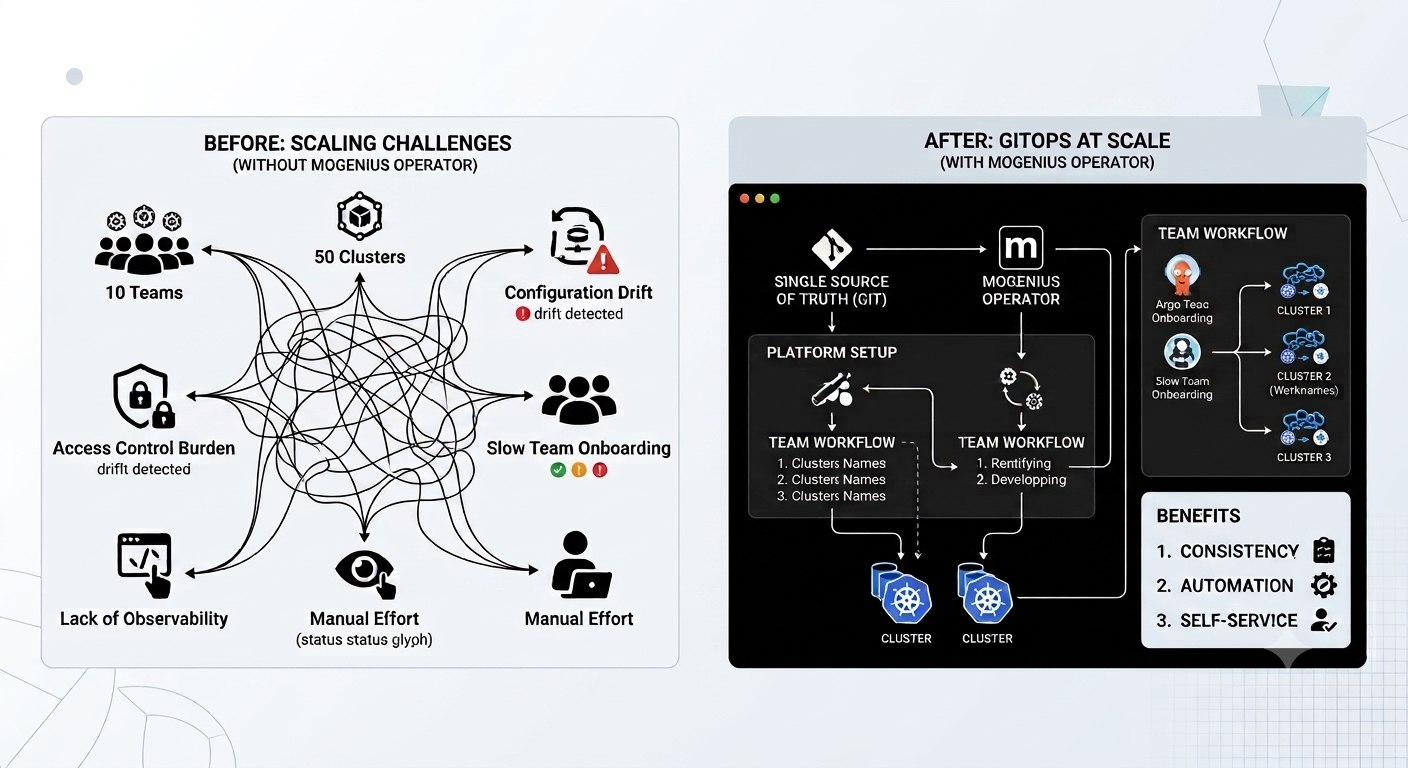
GitOps adoption is straightforward in small setups. Multi-cluster environments with multiple teams introduce several challenges:
Configuration Drift: Maintaining consistent configurations across clusters is difficult. Without automation, clusters can diverge, causing errors that are hard to debug.
Access Control: Managing permissions across multiple clusters and teams becomes burdensome and introduces security risks.
Observability: Monitoring application and infrastructure states across dozens of clusters requires a centralized system to track health, sync status, and deployment history.
Team Onboarding: New teams must be able to start quickly with correct tools and configurations. Manual onboarding is slow and error-prone.
Concrete example: With 10 teams managing 50 clusters, even small manual changes can cascade into inconsistent environments and downtime.
ArgoCD as the Core GitOps Engine
ArgoCD is a continuous delivery tool for Kubernetes, designed for declarative application deployment.
How ArgoCD Works
ArgoCD continuously monitors Git repositories. When a change is detected, it compares the desired state in Git to the live state in the cluster. Differences trigger automatic reconciliation.
Declarative Deployment: All applications, services, and infrastructure are defined as code in Git.
Sync Strategies: Manual, automatic, and self-healing sync options allow teams to choose the level of automation per application. Self-healing can automatically correct drift, while manual sync provides controlled rollout.
This ensures predictable, auditable deployments across clusters.
Introducing the mogenius Operator for Multi-Cluster Management
While ArgoCD manages applications effectively within each individual cluster, mogenius also operates on a per-cluster basis. What changes at scale is the developer experience: the mogenius UI and its abstraction layer make working with ArgoCD across many clusters and teams far simpler than juggling standalone instances. The mogenius Operator provides this abstraction.
Abstracting Multi-Cluster Complexity
The mogenius Operator acts as the control plane for the Kubernetes fleet. Platform engineers define the desired state for all clusters using a higher-level API.
mogenius deploys one ArgoCD instance per cluster. The mogenius Operator runs alongside it, providing the developer-facing abstraction layer, aggregating logs, and combining status information from both the cluster and ArgoCD into a single view.
Self-Service Environments
mogenius's GitOps integration rests on two pillars. First, an opinionated, turnkey setup: mogenius ships a ready-to-use ArgoCD workflow out of the box, so platform teams don't have to assemble and wire together GitOps tooling themselves. Second, deep integration into the mogenius UI: developers can work according to GitOps principles without ever touching a YAML file, while keeping full visibility into the entire process and their workloads. Platform engineers define templates for environments, and development teams provision fully configured clusters or namespaces, either through the UI or by committing a small Git manifest, without needing deep Kubernetes expertise.
Multi-Team GitOps Workflow
Let's look at a concrete scenario with two development teams, Team Alpha and Team Beta, each deploying a service to a different cluster environment managed by the mogenius platform.
Platform Setup: The Platform Engineering team uses the mogenius Operator to deploy and manage a dedicated ArgoCD instance on each target cluster (e.g., staging-cluster and prod-cluster).
Team Configuration: Teams don't need to hand-write an ArgoCD ApplicationSet themselves. Once a team defines their application in mogenius (see step 3), mogenius automatically creates and manages the corresponding ApplicationSet in the background, telling ArgoCD which Git repository to watch for which team on which cluster.
Team Alpha Deployment:
Team Alpha configures their application through the mogenius UI, using pre-built templates instead of hand-writing YAML. mogenius generates the required manifests from this configuration and commits them to the team's Git repository.
ArgoCD, managed by the mogenius Operator on the prod-cluster, detects the change.
ArgoCD synchronizes the change, deploying the new service version to the production cluster. The team can track the entire workflow, from commit to the resulting logs and events of their workload, directly within mogenius, with no YAML files to manage and no tool hopping.
Team Beta Deployment:
Team Beta needs a new staging environment. They commit a simple manifest to the main configuration repository, which triggers the mogenius Operator.
The Operator provisions the new cluster (or namespace), installs ArgoCD, and applies the base platform configurations automatically.
Team Beta then commits their service code, and ArgoCD deploys their service to the new staging cluster.
This workflow divides responsibilities clearly: platform engineers manage the platform (via the Operator), and development teams manage their applications (via ArgoCD), either through the abstracted mogenius UI or directly via Git. In both cases, every change ultimately runs through Git.
Benefits: Consistency, Automation, and Self-Service
Benefit
Platform Engineers
CTOs and Engineering Leaders
Consistency
Easily enforce security policies and platform standards across all clusters from a single source of truth.
Reduces risk of configuration errors and simplifies compliance and audits.
Automation
Eliminates manual, repetitive tasks like configuring new clusters or installing standard agents.
Speeds up the delivery pipeline and frees up valuable engineering time for core product development.
Self-Service
Allows teams to provision their own environments without direct platform engineer intervention.
Improves developer experience (DevEx) and increases team agility and deployment frequency.
Scaling GitOps with ArgoCD and the mogenius Operator transforms cluster management into a predictable, automated, and auditable process.
Do you still need a separate ArgoCD setup if you use a Kubernetes platform tool?
Not necessarily. Platform tools like mogenius don't replace ArgoCD, they deploy and manage it, typically one instance per cluster, and add a UI and abstraction layer on top so developers and platform teams don't need to work with ArgoCD directly or write YAML by hand.
How can platform teams manage ArgoCD consistently across many clusters?
By running an operator alongside ArgoCD on every cluster. The mogenius Operator, for example, runs next to the ArgoCD instance on each cluster, provides a developer-facing abstraction layer, aggregates logs, and combines status information from both the cluster and ArgoCD into a single view.
Can developers follow GitOps practices without writing Kubernetes YAML by hand?
Yes, with the right platform layer. mogenius, for instance, lets teams configure their applications through templates and a UI, then generates the required manifests automatically and commits them to the connected Git repository, so developers follow GitOps principles without writing YAML by hand.
How do you avoid manually creating an ArgoCD ApplicationSet for every team?
By automating ApplicationSet creation at the platform level. In mogenius, each cluster runs its own ArgoCD instance managed by the mogenius Operator, and when a team defines an application, mogenius automatically creates and manages the corresponding ArgoCD ApplicationSet in the background.
Does GitOps still work if some developers prefer a UI over raw Git commits?
Yes. With mogenius, development teams can work either through the abstracted UI or directly via Git commits. In both cases, every change ultimately flows through Git, keeping the repository as the single source of truth.
Interesting Reads
Best practices
-
Jan Lepsky
-
December 17, 2025
GitOps for Developers: Fundamentals, Practical Challenges and How to Make It Work
Master GitOps fundamentals and overcome developer hurdles. Learn how platform abstractions and templates simplify Kubernetes deployments for faster scaling.
Best practices
-
Jan Lepsky
-
September 16, 2024
How Kubernetes YAML Manifests Are Dragging Down Developer Productivity
YAML overhead slows teams down. Discover how abstractions and platform tools cut configuration complexity and help developers ship faster.
The latest on DevOps and Platform Engineering trends
Subscribe to our newsletter and stay on top of the latest developments
Thank you! Your submission has been received!
Oops! Something went wrong while submitting the form.