mogenius vs. OpenShift
Red Hat’s application platform including its own Kubernetes runtime.
Backstage and mogenius are both counted as internal developer platforms, and they are built on opposite premises. Backstage is, in its own documentation, an open source framework for building developer portals: you create the app, choose the plugins, and operate the result. mogenius is a finished platform that connects to the Kubernetes clusters you already run. What follows compares the two on the points that decide it in practice: what you have to build, what developers can do without waiting, and what stays provable afterwards.

VS.
mogenius is a platform for the developer lifecycle on Kubernetes. It connects to existing clusters through an open-source operator and provides workspaces per team, central RBAC and SSO, GitOps pipelines, built-in monitoring, and audit trails, without a platform project in front of it.
Backstage, created at Spotify and donated to the CNCF, is an open source framework for building developer portals. It has been a CNCF incubating project since March 2022 and ships a Software Catalog, Software Templates, TechDocs, and a plugin ecosystem that you assemble into your own portal.
Both are counted as internal developer platforms, so the labels do not separate them. What separates them is whether you are building a portal or connecting a platform, and what each one covers once it runs.
A finished platform. Workspaces, RBAC and SSO, pipelines, monitoring, and audit trails are part of the product, extensible through API, CLI, and SDKs.
A framework for building your own portal, per the official documentation. The Software Catalog, Software Templates, TechDocs, and the plugin ecosystem are the building blocks; the portal is what your team makes of them.
Connects to clusters through an open-source operator and operates on them: deployments, environments, logs, events, and access control.
The Kubernetes feature exists so service owners can view and monitor the workloads their services own. The documentation states it is not aimed at cluster administration.
Development teams and the platform engineers who set their boundaries, on the infrastructure the organisation already has.
Organisations with a platform team that builds the portal, integrates the plugins, and keeps both current.
A Helm chart on an existing cluster, and a first cluster is typically connected in minutes. The platform layer is consumed rather than built.
You create your own app with create-app on Node.js LTS and Yarn, initially against an in-memory SQLite database. The docs state that this is not a production-ready installation and holds no organisation-specific data until you set up integrations.
Workspaces and central RBAC with SSO from the first day. Developers work without a cluster credential of their own, and every action stays attributable.
A permission framework is available but not enabled by default: the docs note that by default endpoints are not protected. Policies are authored in code or configured through RBAC or an external authorization provider.
Developers deploy without tickets and without kubectl: environments per team, abstracted deployment forms, plus templates and golden paths defined once by platform engineers.
Software Templates create new projects from a template, and the Software Catalog makes services and ownership discoverable. What a template then triggers depends on the plugins behind it.
GitOps pipelines with Argo CD integration that run build, deployment, and rollback per application.
Existing pipelines are surfaced in the portal through plugins. The portal shows the state; the pipelines stay where they are.
Policies, roles, and audit trails across all connected clusters, plus ISO 27001 and PCI-DSS evidence generated continuously from live operational data, CB-validated by TÜV Rheinland.
An auditor core service records security-relevant events. The events themselves are instrumented in code by plugin authors and integrators.
AI Agents and AI Chat run inside the existing workspace and RBAC boundaries. Every AI action is attributed to an identity and recorded in the audit log.
The documented out-of-the-box components are the catalog, templates, TechDocs, and plugins. AI assistance comes from plugins or from what the team builds itself, and it is governed by whatever that plugin implements.
Running Kubernetes for teams: shipping, operating, access, and evidence, without building and maintaining the platform first.
One portal across a large estate: service catalog, ownership, documentation, and templates, shaped exactly around the organisation that builds it.
*This comparison does not cover every feature. It is based on publicly available vendor documentation as of July 2026. Both products develop continuously, so check the current vendor documentation for anything that matters to your decision.

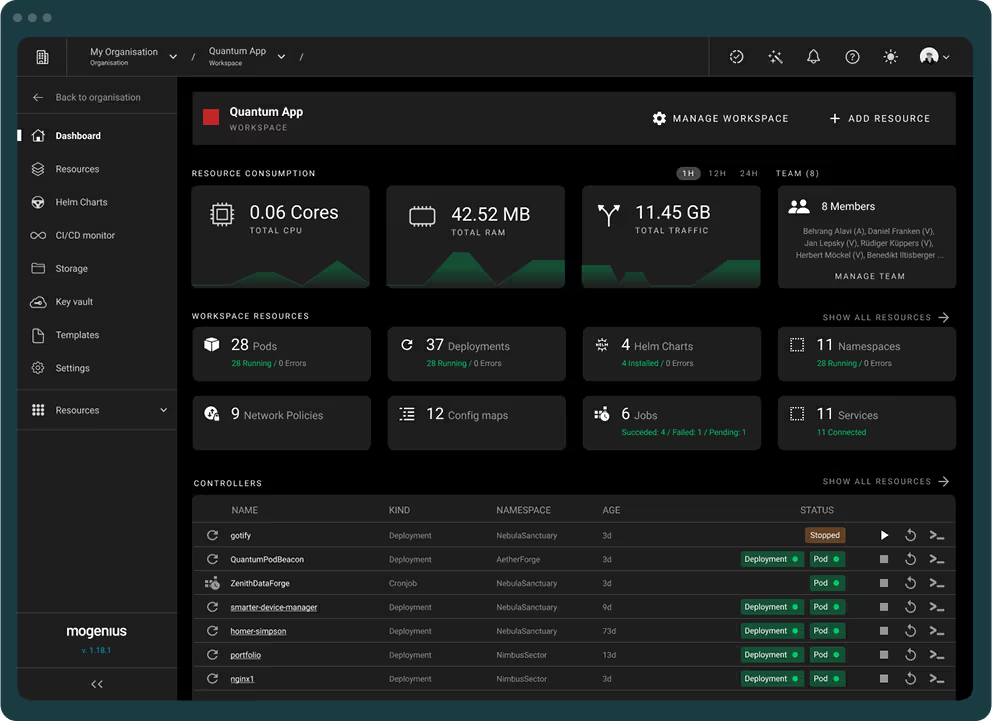
Backstage answers a real problem: in a large estate, nobody knows which services exist, who owns them, or where the documentation is. The Software Catalog and TechDocs answer exactly that, and the plugin architecture lets an organisation shape the portal around its own toolchain. What Backstage does not do is operate Kubernetes. Its own documentation describes the Kubernetes feature as a way for service owners to view and monitor their workloads, not to administer clusters, and the getting-started guide states plainly that a fresh installation is not production-ready until you wire up your own integrations. mogenius starts from the other end. It connects to the clusters you already run and covers what happens on them: deployments and environments per team, central RBAC and SSO, GitOps pipelines from commit to environment, monitoring, and audit trails with compliance evidence. The two are not mutually exclusive. Organisations that have built a Backstage portal keep it as the front door and use mogenius as the layer that actually runs the workloads behind it.
Get started effortlessly with an optimized setup process that reduces time to productivity
Organize your resources efficiently and monitor performance across different environments.
Enhances security by defining roles and permissions, ensuring that users have access to only what they need.
Integrate effortlessly with your CI/CD pipelines for streamlined deployments.
Adaptable platform that grows with your needs, providing customizable solutions.
Quickly identify and resolve issues with real-time logging, alerts, and resource topology views that surface problems before they impact operations.
Built-in AI Agents and AI Chat let teams interact with their clusters safely, governed by the same RBAC and workspace structure that controls all other access.
Native GitOps workflows and Single Sign-On support are included without additional plan upgrades.








Backstage is an open source framework for building developer portals: your team creates the app, selects plugins, and operates it. mogenius is a finished Kubernetes platform that connects to existing clusters and covers the developer lifecycle on them: self-service deployments, workspaces per team, central RBAC and SSO, GitOps pipelines, monitoring, and audit trails. One is a construction kit for a portal, the other is a platform for running Kubernetes.
Backstage fits organisations with a large service estate and a platform team that can build and maintain a portal, and whose main problem is discoverability, ownership, and documentation across many teams. mogenius fits teams whose problem is running Kubernetes itself: shipping without tickets, governed access, and evidence, without staffing a platform project first. The deciding question is whether you want to build a portal or operate clusters.
Yes. mogenius manages multiple clusters from one interface with RBAC that applies across all of them. Clusters connect through an open-source operator, in the cloud, on premises, or at the edge, and policies and templates apply cross-cluster.
mogenius includes AI Agents and AI Chat natively. AI actions run inside the existing RBAC and workspace boundaries, each action is attributed to an identity, and everything is recorded in the audit log. An AI agent therefore cannot reach beyond the scope its identity holds.
Yes, and that combination is common. Backstage stays the front door with catalog, ownership, and documentation, while mogenius runs the workloads behind it: environments per team, GitOps pipelines, monitoring, RBAC, and audit trails on the clusters themselves. Backstage is a portal framework and does not manage clusters, so the two cover different parts of the same lifecycle.
Day-to-day use does not require deep Kubernetes knowledge: developers deploy through abstracted forms and pre-configured GitOps workflows. Setup is a single Helm chart on an existing cluster, and a first cluster is typically connected in minutes.
Book a walkthrough of mogenius on your own clusters, or see what it covers alongside Backstage first.
Certifications & Memberships





mogenius is a CNCF Silver Member, a NeoNephos Foundation member, a Certified Kubernetes product, and ISO 27001 certified via TÜV Saarland.