
Best practices
-
-
Dependency Updates Shouldn't Be Your Biggest Operational Risk
Dependency drift is a silent reliability killer. Learn how the open-source Renovate Operator delivers self-hosted dependency governance for Kubernetes at scale.

Here's a question most platform engineers can't answer confidently: of all the repositories in your organization, how many actually had a successful Renovate scan this week?
If you're running Renovate via CronJobs — which is the most common self-hosted setup — the honest answer is probably "I don't know." CronJobs don't give you visibility. They don't tell you when a scan was skipped because of a resource conflict; they don't alert you when a secret expired and every job silently started failing. They definitely don't show you which of your 150 repos have been drifting for three months.
The mogenius Renovate Operator replaces this entire setup with a Kubernetes-native operator. You define update policies as CRDs, the operator handles scheduling and execution, and you get a web dashboard that shows what's actually happening.
Renovate by Mend is the engine. It scans your repos for outdated dependencies: npm packages, Go modules, Helm chart versions, Docker image tags, Kustomize bases, and Terraform providers. It then opens PRs with the updates. It supports grouping, automerge rules, and scheduling. It's excellent at what it does.
The problem isn't the engine; it is the deployment model.
Running Renovate via the CLI or a basic CronJob means you're managing scheduling, secret injection, resource limits, and failure handling yourself. At 5 repos, this is fine. At 50, it's tedious. At 200+, it's a maintenance burden that generates exactly the kind of operational toil Renovate was supposed to eliminate.
The Mend Community Edition (CE) improves on this, but it runs as a single container with limited observability and no Kubernetes-native integration. There are no CRDs, no RBAC, and no Prometheus metrics.
The Renovate Operator (MIT licensed) treats dependency management as a first-class Kubernetes workload. Instead of a CronJob manifest, you define a CRD:
apiVersion: mogenius.com/v1alpha1
kind: Renovate
metadata:
  name: backend-services
  namespace: renovate-operator
spec:
  schedule: "0 2 * * 1"   # Every Monday at 2 AM
  parallelism: 3
  renovateConfig:
    extends: ["config:base"]
    platform: github
    automerge: true
This gives you features that CronJobs cannot provide:
kubectl apply rejects it immediately. Config errors are no longer discovered at 2 AM when the job runs.CRD status reflects the actual state of each project: scheduled, running, completed, or failed. Query it with kubectl get renovate like any other resource.
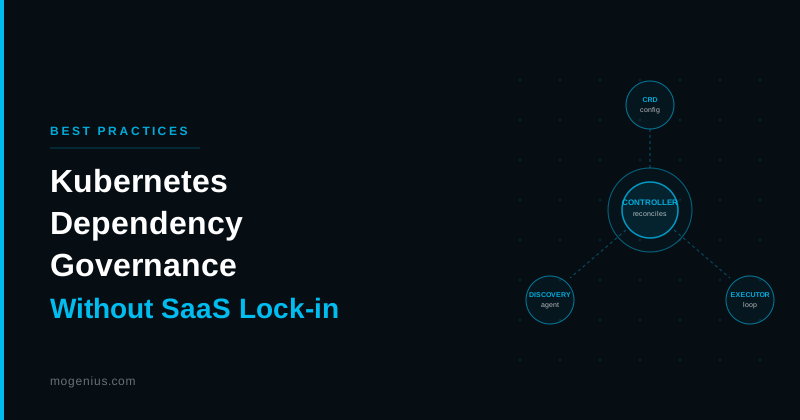
The operator runs three components in a control loop:
CRDs and manages scheduling. It reconciles every 60 seconds, syncing desired state with actual state.-autodiscover and it crawls your GitHub, GitLab, Bitbucket, Azure DevOps, Gitea, or Forgejo organizations to find all repos and register them. New repos are picked up automatically on the next cycle.spec.parallelism. If you set it to 3, only 3 Renovate jobs run concurrently. This prevents the API rate-limiting issues that hit teams running dozens of CronJobs simultaneously.
The fastest path to deployment:
helm -n renovate-operator upgrade --install renovate-operator \
  oci://ghcr.io/mogenius/helm-charts/renovate-operator \
  --create-namespace --wait
Or via the Helm repository:
helm repo add mogenius https://helm.mogenius.com/public --force-update
helm -n renovate-operator upgrade --install renovate-operator \
  mogenius/renovate-operator --create-namespace --wait
The current version is 3.2.1. The chart is also available on Artifact Hub.
GitHub or GitLab webhooks to trigger on-demand scans, useful for running Renovate immediately after a new release.
The operator ships with sensible security out of the box. All worker jobs run as non-root with RuntimeDefault seccomp profiles. Resource requests and limits are set on every job, preventing scans from starving production workloads. Git credentials are stored as Kubernetes Secrets and never leave the cluster. For teams using HashiCorp Vault or AWS Secrets Manager, it supports the External Secrets Operator.
When to use this over other options: Use the Renovate Operator if you are running Kubernetes, managing more than a handful of repositories, and want CRD-based configuration with native monitoring. Stick with CronJobs if you have fewer than 10 repos and don't need visibility.
Resources:
The CLI is the engine. The operator wraps it in a Kubernetes-native control loop with CRD configuration, parallel execution, auto-discovery, and a dashboard.
Set spec.parallelism on your CRD. The Executor Loop queues jobs and runs them within that concurrency limit.
The project has 139 releases and over 500 commits. The current version is 3.2.1, released in March 2026.
Subscribe to our newsletter and stay on top of the latest developments
