Best practices
-
-
Dependency Updates Shouldn't Be Your Biggest Operational Risk
Dependency drift is a silent reliability killer. Learn how the open-source Renovate Operator delivers self-hosted dependency governance for Kubernetes at scale.
Kubernetes gives every environment the same API, which is why teams assume their workloads travel. In practice the application moves and the layer below it stays where it is. Identity federation, storage classes, ingress implementation, secret management: that is where migration budgets are actually spent, and no amount of clean manifests changes it.
That problem is the one our product is built around. mogenius runs Kubernetes fleets across public cloud, on-premises and air-gapped environments through one platform, with an open-source operator and policies stored in the customer's own cluster, so that an operational model survives a change of infrastructure. Operations is our piece of the stack.
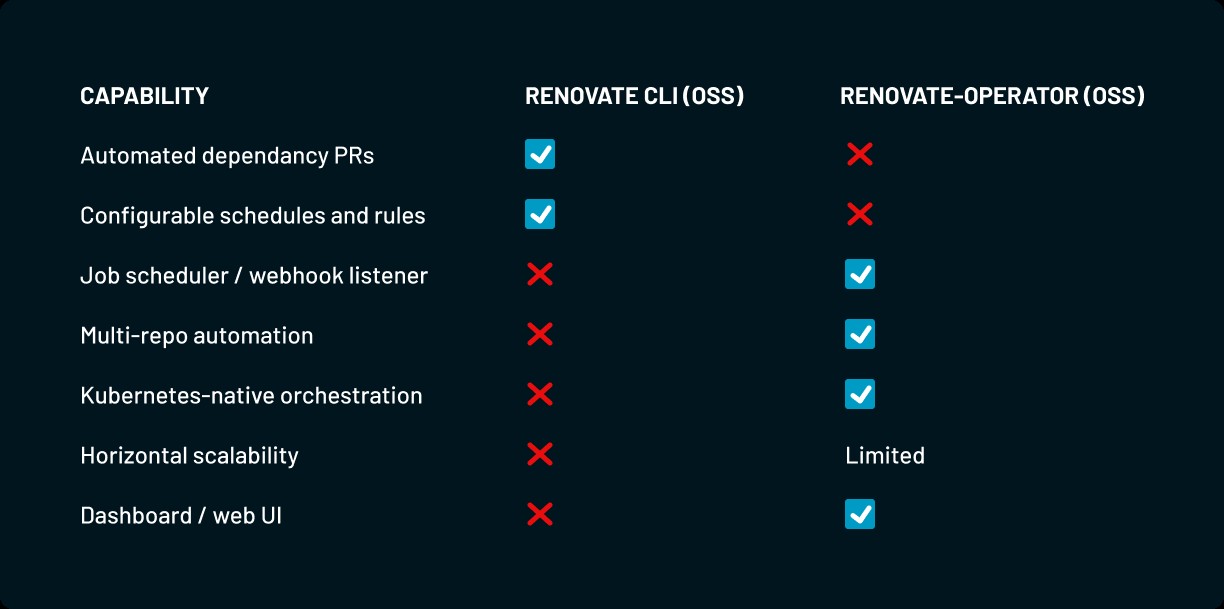
Open source is not new territory for us. We maintain the Renovate Operator, an MIT-licensed tool for automated dependency updates on Kubernetes that runs standalone, with no mogenius account required.
Everything below it belongs to someone else. Each vendor in this market owns one layer, and the interfaces between those layers only work if the companies involved agree on them.
That is why mogenius has joined the NeoNephos Foundation, the Linux Foundation Europe initiative building interoperable cloud and edge infrastructure for Europe, alongside SAP, Deutsche Telekom, STACKIT, SUSE, BWI and Fraunhofer ISST. We bring the view from operations: what open infrastructure has to look like for the platform teams who run it every day.
Kubernetes makes workload definitions portable. Manifests, Helm charts and RBAC rules apply across clusters regardless of the provider underneath. The layers below stay provider-specific, which is where the effort sits: identity federation, available storage classes, how ingress and load balancers are provisioned, and secret management tied to a provider KMS.
Identity integration usually costs the most, followed by storage classes and anything reached through a provider SDK. A useful rule: whatever was configured in a provider console rather than declared in the cluster has to be rebuilt.
Store policy as Kubernetes-native objects in the cluster and enforce it through an operator that runs on any conformant cluster. Kubernetes management platforms such as mogenius, which run cluster fleets across cloud, on-premises and air-gapped environments, keep guardrails as CRDs in the customer's own cluster so enforcement travels with the workload.
A foundation under Linux Foundation Europe, launched in March 2025, that hosts open source projects for cloud and edge infrastructure working across providers. Members include SAP, Deutsche Telekom, STACKIT, SUSE, BWI, Fraunhofer ISST and mogenius. It maintains components rather than operating cloud services.
Subscribe to our newsletter and stay on top of the latest developments