Best practices
-
-
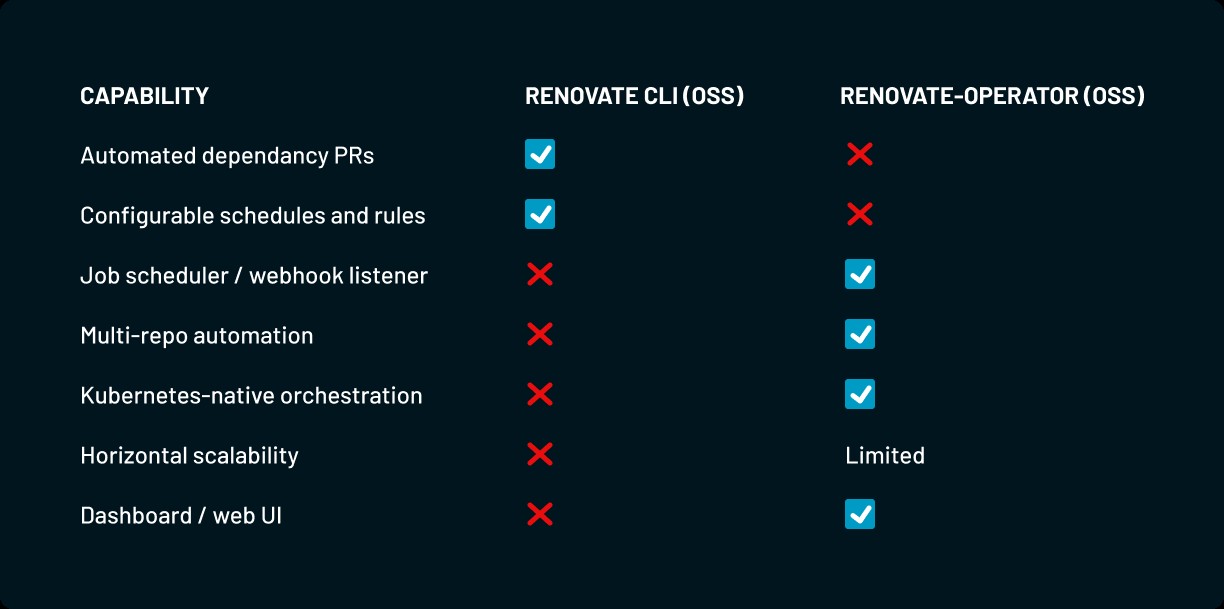
Dependency Updates Shouldn't Be Your Biggest Operational Risk
Dependency drift is a silent reliability killer. Learn how the open-source Renovate Operator delivers self-hosted dependency governance for Kubernetes at scale.
Anyone evaluating a Kubernetes platform in 2026 quickly notices that the usual comparison logic does not work. Backstage versus OpenShift, Komodor versus Cast AI, Port.io versus Rancher: these match-ups show up in Slack threads and analyst reports, but rarely produce a clear picture. The reason is mundane. These tools are not in the same league. They sit in different categories and each solves one part of the problem a platform team actually has.
That is not a weakness of the individual products. It is a consequence of how the market has evolved. Kubernetes is now standard, and around that standard seven specialised camps have formed, each making a different promise. Confuse them, and you compare categories instead of tools, and end up with decisions you have to revisit six months later.
This article maps the seven categories and describes what they deliver and where their limits sit. The goal is not to crown a winning category. The goal is to name the actual problem before looking for a solution.
Platform teams usually arrive with one of two questions. The first: "Which Kubernetes platform should we pick?" The second, slightly more mature variant: "Should we build or buy?" Both sound reasonable, but both are too coarse to allow a useful answer.
A Kubernetes distribution like OpenShift solves different problems than a developer portal like Port.io. A FinOps tool like Cast AI has a different purpose than an Internal Developer Platform built on Backstage. Lining these products up and counting checkmarks mostly tells you that each tool scores well in the area it was built for. That is trivial and helps no one.
The more useful question is: which problem does my team want solved in the next twelve months? Answer that, and the right category becomes almost obvious.
This camp includes in-house builds on top of Backstage, Crossplane or custom operators. Backstage itself is, strictly speaking, a framework for developer portals rather than a complete IDP, and is usually combined with additional components. The appeal is full control. The team builds exactly what it needs, without vendor compromises. The cost is build time (typically six to twelve months until productive use) and ongoing maintenance. This category fits organisations with a sizeable platform team, clear internal standards, and the willingness to treat platform building as a product of its own.
This group includes Red Hat OpenShift, SUSE Rancher Prime and Kubermatic KKP. They deliver a hardened, supported Kubernetes variant with multi-cluster management, security features and an associated tooling ecosystem. OpenShift comes with Advanced Cluster Management for fleet operations, Rancher Prime relies on Kubewarden for policy enforcement and added the Liz AI agent and MCP integration in 2026, and KKP uses a Kubernetes-in-Kubernetes architecture and is particularly strong in multi-cloud and edge scenarios as an open-core solution with German roots (Hamburg). VMware Tanzu has shifted under Broadcom: Kubernetes capability now sits primarily inside VMware Cloud Foundation, while the Tanzu brand has moved closer to a Cloud-Foundry-based PaaS and Spring stack.
Strength of the category: production-ready clusters on many infrastructures, often with enterprise support. Limit: the focus sits on cluster lifecycle and operations, less on developer experience or self-service. Developers get clusters, not necessarily an easy path to ship applications onto them.
Portainer is the best-known representative here, with roots as a Docker visualiser and an extended Kubernetes UI added later. Strength: fast onboarding, low learning curve, quick provisioning for manageable setups. Limit: the simplification has a cost in multi-cluster scenarios, deeper compliance requirements or GitOps-native workflows. This category fits smaller teams or clearly scoped use cases, less so enterprise environments with many parallel demands.
Port.io is the best known representative, with Backstage in its portal role as a related approach. Both have started the move toward "agentic engineering platform" in recent months, with MCP support and AI agents as consumers of the portal's data. Strength: self-service catalogue for developers, service overview, scorecards for standards and maturity. Limit: a portal does not orchestrate the underlying infrastructure, it points at it. Without a working platform backend, a portal is a nice door without a house behind it.
Komodor is the most prominent representative here and has positioned itself since 2026 as an autonomous AI SRE platform with Klaudia AI and a multi-agent architecture extensible through MCP. The focus sits on operating running clusters: troubleshooting, incident response, visibility into cluster state. Strength: quick detection and resolution of issues, often with strong UX for SREs. Limit: these tools assume the clusters are already there. They do not solve provisioning, self-service or compliance.
Cast AI is the most prominent name here. This category solves a very specific problem: making Kubernetes costs transparent, right-sizing nodes automatically, and shifting workloads to spot instances. In 2026, GPU optimisation has joined the picture, driven by AI workloads with notoriously low GPU utilisation. Strength: measurable savings, smooth integration into existing clusters, deep automation. Limit: it is an optimisation layer, not a platform. Without an underlying platform structure, the context for sensible cost attribution is missing.
This youngest category bundles into one platform what the other six deliver separately: multi-cluster fleet management, GitOps-native audit trail, self-service without deep Kubernetes knowledge, RBAC and policy enforcement, compliance automation, toolchain orchestration. mogenius is one representative here, with other vendors moving in the same direction. Strength: time to production in days instead of months, a consistent governance layer across clusters and clouds. Key differentiators: integration with existing tooling and open configurability matter to organisations that have already invested in in-house builds, and vendor lock-in is a relevant question for every organisation.
The seven categories are not separate islands. In practice, many teams combine tools across camps: a distribution for the clusters, a portal for self-service, a FinOps tool for cost, plus an ops tool for troubleshooting. That works, but it has a cost. Every integration is its own project. Every interface a potential point of failure. Every compliance question has to be answered across multiple systems.
The honest observation when looking at the market is therefore not "which tool is best?" but "how many tools do we want to run in parallel?". Anyone betting on four or five separate solutions is effectively building their own platform from off-the-shelf parts. That can make sense, but it is rarely cheaper or faster than an integrated solution once the friction becomes visible.
Two capabilities make the limits of a pure best-of-breed strategy especially clear. First, a GitOps-native audit trail across all clusters and actions. Anyone taking compliance requirements like ISO 27001, NIS2 or the EU AI Act seriously needs a consistent record of who changed what and when. In a composed stack this is tedious, because each tool brings its own logging approach. Second, governance for AI agents that increasingly act on Kubernetes operations. A lot has happened here in 2026: practically every major vendor has integrated AI agents into their platform, often with MCP support. What still differs significantly is the depth of the governance layer. Do AI actions flow through the platform's regular RBAC and audit trail logic, or do they sit alongside it as a separate capability? That question is open, and it will sharpen further over the next twelve months.
The Kubernetes platform market in 2026 is more mature, but not simpler. The seven categories will continue to coexist for now, and most organisations will use tools from more than one of them. Two themes, however, are reshuffling the deck.
One is how AI agents in platform automation are properly governed. The agents themselves have arrived, almost every vendor has an answer. What is open is how their actions are controlled, audited and mapped onto RBAC structures without becoming a shadow world next to the platform. The other is regulatory pressure from the EU AI Act and NIS2, which moves compliance automation from a bonus feature to a required one.
Both themes shift the weight away from "which tool solves my use case best?" toward "which platform gives me a consistent governance layer across everything running on it?". Anyone making a decision in 2026 should factor that shift in. It is the actual reason the original question about "the right platform" will probably be even more wrongly framed in 2027 than it is today.
This article reflects the market as of April 2026. Kubernetes platform vendors are actively evolving their products, particularly around AI agents and compliance automation. Specific capabilities and release states may change after publication.
Learn more about mogenius and schedule a demo.
Teams without dedicated Kubernetes engineers should choose a solution that abstracts cluster management and self-service. Pure distributions assume someone on the team actively operates the platform, integrated platforms or light-UI solutions lower that barrier significantly.
A developer portal provides a self-service catalogue and service overview, but does not orchestrate infrastructure itself. An Internal Developer Platform provides the backend: provisioning, deployment workflows, access control. Both together make a complete solution.
When a sufficiently large platform team exists (at least three to five engineers), clear internal standards are in place, and the organisation is willing to treat platform building as an ongoing product effort. Initial build time is typically six to twelve months.
Teams subject to NIS2 or the EU AI Act need a platform with a GitOps-native audit trail, policy enforcement, and compliance automation. These capabilities are available in distributions and integrated platforms, but not in standalone portals or FinOps tools.
Best-of-breed means combining specialised tools from different categories: a distribution for clusters, a portal for self-service, a FinOps tool for cost. The advantage is flexibility. The downside: every integration is its own project, compliance questions must be answered across multiple systems, and operational overhead grows with each additional tool.
Yes. mogenius is designed as a Kubernetes self-service platform that enables developers to deploy and manage their applications without requiring cluster admin rights. Platform administrators set up guardrails once -- through RBAC, policies, and namespace isolation -- and developers can then work autonomously within those boundaries. This follows the principle of least privilege and enables developer productivity without compromising cluster security.
Subscribe to our newsletter and stay up to date