Beta Launch: Introducing AI Insights for Kubernetes Troubleshooting
Jan Lepsky
In our previous article on using AI the right way, we explored how context-aware AI troubleshooting can reduce organizational friction in Kubernetes, making it operable at scale while keeping platform teams in control. Today, we introduce AI Insights, a tool designed to bring these principles into practical workflows.
The Reality: Why Kubernetes is Still a Bottleneck
Kubernetes is rarely a bottleneck because it lacks features. It becomes a bottleneck because too few people can operate it confidently when something goes wrong. Day-2 operations still require manual correlation across logs, events, metrics, rollouts, and configuration history. The result is predictable. Developers escalate early, platform teams become permanent first responders, and operational load grows faster than the organization.
AI Insights is designed to break this pattern.
Kubernetes Bottlenecks Are About Dependency, Not Tooling
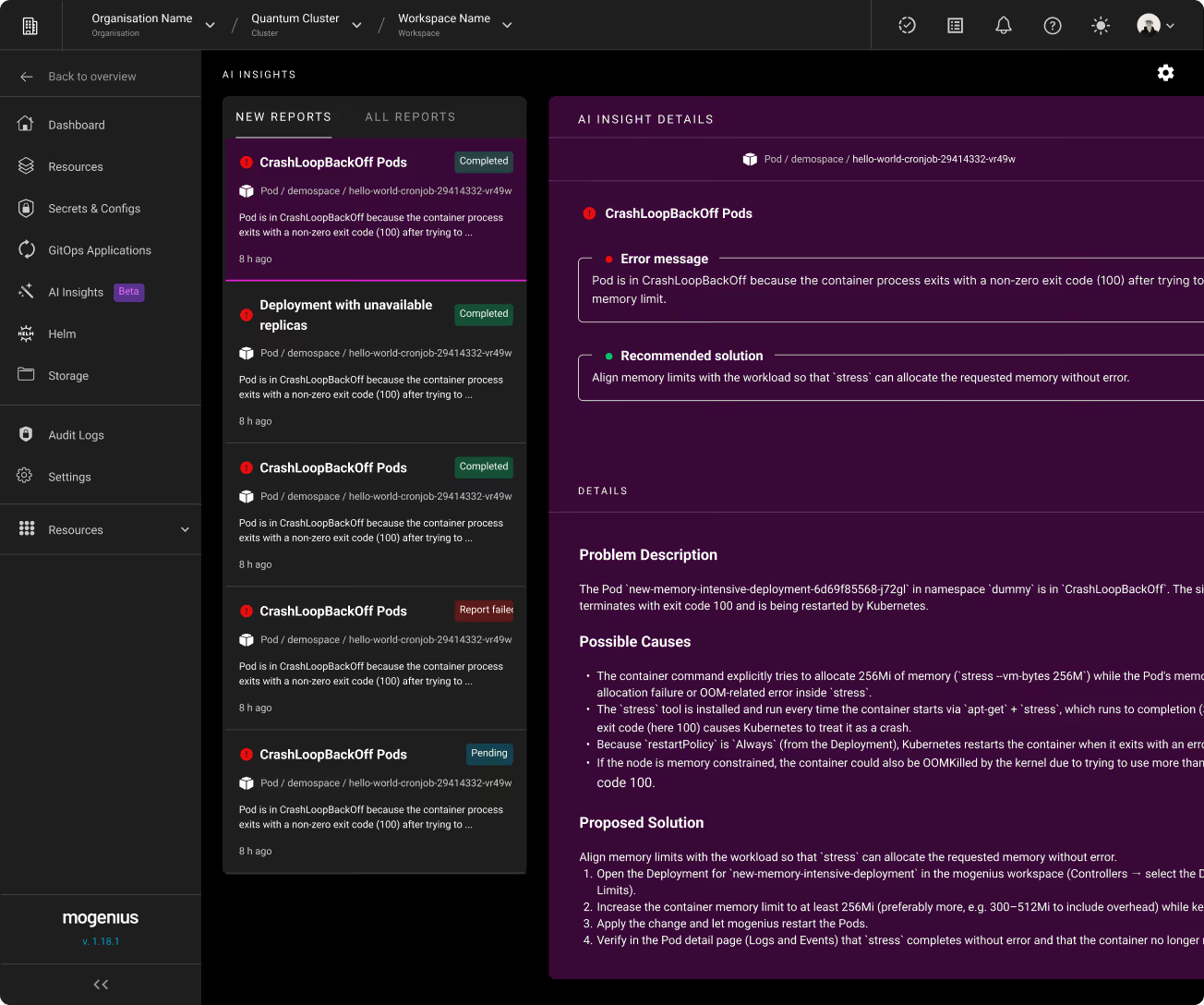
Most teams already have kubectl, metrics dashboards, logs, and Git history. What they lack is a shared, accessible understanding of how failures unfold across time and systems. AI Insights introduces a consolidated, context-aware analysis layer built on data collected by the mogenius operator. The goal is simple: reduce dependency on Kubernetes experts without reducing control.
Empowering Your Developers: Three Core Benefits of AI Insights
The mogenius AI Insights Beta is engineered to immediately impact your team's efficiency by focusing on three essential outcomes: Clarity, Action, and Productivity.
1. Instant Clarity Across Cluster Signals
AI Insights correlates:
logs and restarts
rollout history
config changes
resource metrics
eBPF traffic data
probe configuration
node conditions
Helm releases
Failures are presented as timelines, not fragments.
Your Benefit
You get a single, human-readable report that translates complex cluster chaos into a clear, targeted diagnosis. Every developer on your team, regardless of Kubernetes experience, can understand the issue and move to the next step without escalating to platform experts.
2. Specific, Contextual Recommendations
Generic troubleshooting advice is rarely useful. Recommendations become actionable only when they refer to specific resources with concrete values.
Example: Memory-Related Container Termination
If a container exits due to memory pressure:
the affected deployment is identified
relevant events are extracted
the OOMKilled value is explained
the current limits are compared with observed usage
a corrected configuration is generated
Your Benefit
If the AI determines your Pod was killed due to memory pressure, it identifies the exact deployment that requires the fix, suggests the specific new value, and provides the exact YAML snippet. This eliminates the manual effort of drafting the fix and reduces the time from diagnosis to deployment from hours to minutes.
3. Structured Inbox for Diagnosed Issues
Clusters generate noise: transient restarts, ephemeral connection drops, and short-lived scheduling issues. AI Insights filters these events and provides a curated set of reports that include:
a description of the issue
a summary of correlated signals
the likely root cause
recommended next steps
optional one-click actions for routine fixes
Your Benefit
Your team receives a prioritized list of pre-diagnosed, actionable reports. We present the issue, the root cause, and the fix recommendation in one place. For many common scenarios, a one-click action allows your team to resolve the issue directly in the platform, freeing time for complex, high-value tasks.
From Individual Expertise to Shared Operational Intelligence
Every diagnosis reinforces a shared understanding of the system:
why it failed
what changed
what fixed it
This replaces tribal knowledge with platform knowledge. Teams learn implicitly, without runbooks or training sessions. It turns AI insights from just a troubleshooting tool into a mechanism for scaling operational intelligence across the organization, reducing dependency on platform experts and accelerating adoption of Kubernetes.
Architecture, Governance, and Control
Data Residency
The AI Insights agent operates on infrastructure hosted in Germany. Logs, events, and configuration data remain under strict regional data residency requirements. The mogenius operator maintains control of cluster-side data flow, ensuring visibility and compliance for teams operating under European governance models.
Integration of Custom AI Models for Organizations
Organizations can integrate their custom AI models using their own API endpoints, whether hosted on the cloud or self-hosted. This allows AI Insights to tailor recommendations to fit internal guidelines for naming conventions, resource sizing, security protocols, and rollout procedures, ensuring alignment with each organization's unique standards.
Cost Control Through Token Management
The analysis process follows a token-based model, providing predictable consumption and clear cost visibility.
Example Workflows Enabled by AI Insights
Misconfigured Probe Detection
readiness failures
startup time exceeds probe delay
concrete recommendation provided
Rollout and Traffic Correlation
Traffic drops traced to:
Helm upgrades
image changes
network policy updates
Controlled Remediation
Fixes applied through the operator:
image updates
Helm upgrades
declarative workflows preserved
Outlook: From Analysis to Controlled Automation
The Beta version focuses on reliable root cause analysis with strong context. Future releases may expand to simulations, predictive checks, and controlled remediation workflows governed by organizational policy. All capabilities rely on explicit human oversight, clear audit trails, and operator-enforced safety boundaries. AI Insights does not replace engineers but makes Kubernetes operable at organizational scale.
If Kubernetes is currently a support bottleneck in your organization, AI Insights is designed to remove it.
How does AI Insights empower non-expert Kubernetes developers?
It provides clear, concise diagnoses and the exact fixes in human language, often with a one-click action. Developers no longer need hours of manual debugging or deep knowledge of kubectl workflows for common issues.
How is data sovereignty ensured with the AI agent?
The AI agent’s compute is hosted in Germany and the EU. Cluster data remains under organizational control through the operator architecture, ensuring compliance with local governance rules.
How can platform teams control the costs of AI analysis?
AI Insights uses a token-based consumption model, providing transparency and predictable budgeting.
Can this tool help organizations migrating to Kubernetes?
Yes, AI Insights immediately identifies and resolves post-migration operational issues. For complex planning and architecture, the Professional Services team of mogenius K8s experts is available.
Interesting Reads
Best practices
-
Jan Lepsky
-
January 7, 2026
Troubleshooting with AI in Kubernetes: Why It Matters and How to Use It Responsibly
Discover how AI enhances Kubernetes troubleshooting by bridging operational knowledge gaps. Understand when limited context suffices and when full data correlation is essential for efficient resolution.
Best practices
-
Jan Lepsky
-
April 15, 2025
Basic Kubernetes Troubleshooting: The Ultimate Guide
Learn to troubleshoot Kubernetes fast: From pod failures to network issues, this guide helps you fix cluster problems with real-world tips.
The latest on DevOps and Platform Engineering trends
Subscribe to our newsletter and stay on top of the latest developments
Thank you! Your submission has been received!
Oops! Something went wrong while submitting the form.